
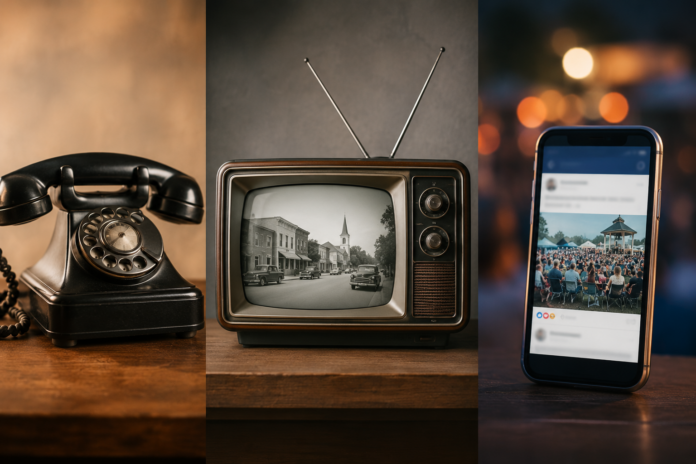

(June 1, 2026) – Throughout history, certain inventions have changed daily life so significantly that it becomes difficult to imagine the world before them.
Over the last century, three technologies stand out for the way they transformed how people communicate, receive information, and stay connected: the telephone, television, and social media.

Each arrived in a different era.
Each changed daily routines.
And each eventually became so common that many people stopped thinking about the impact it had on everyday life.
The Telephone
Before telephones became common in homes and businesses, communication over long distances often required letters, telegrams, or travel.
Information moved more slowly. Families separated by distance could wait days or even weeks to exchange news. Businesses relied heavily on written correspondence. Urgent communication was more difficult and often more expensive.
The telephone changed those expectations.
Conversations that once required days could happen almost immediately. Families stayed connected more easily. Businesses operated more efficiently. Communities gained a faster way to communicate during emergencies and important events.
Over time, the telephone became an ordinary part of life.
Today, it is difficult to imagine a world without it.
Television
Television brought a different type of change.
While the telephone transformed personal communication, television transformed how people received information and entertainment.
For the first time, millions of people could watch the same events from their homes.
News broadcasts, presidential speeches, sporting events, weather coverage, and historic moments reached audiences as they happened. Television created shared experiences across communities and across the nation.
Families gathered around television sets for information and entertainment. Businesses embraced television advertising. Public awareness of major events expanded dramatically.
Like the telephone, television eventually became a normal part of daily life.
Social Media
Social media introduced another major shift.
The telephone allowed people to communicate directly with one another.
Television allowed people to receive information.
Social media combined both experiences while adding something new.
For the first time, ordinary individuals could share information with large audiences almost instantly.
Photographs, videos, announcements, community updates, and personal experiences could reach hundreds or even thousands of people within moments.
Residents of Broussard and Youngsville see this every day. Local businesses announce events online. Schools share information with families. Churches, nonprofit organizations, and community groups promote activities and communicate directly with residents. Community conversations that once occurred in person or by telephone now often take place online.
What once required multiple communication channels can now occur through a single platform.
Looking Back
The most interesting similarity among these technologies may be how quickly people adapted to them.
Each innovation changed daily life in ways that seemed remarkable at the time.
Yet as years passed, each became part of the background of everyday living.
Today, few people stop to think about how the telephone transformed communication or how television changed the way information reached the public.
Social media has followed a similar path.
What once seemed new has become familiar. What once felt innovative has become routine.
Looking back at these technologies offers a reminder that change often happens gradually. By the time a new invention becomes ordinary, it may have already reshaped daily life in ways that people scarcely notice.
The telephone, television, and social media arrived in different generations. Today, all three are woven into everyday life.
That may be the clearest sign of how completely they changed the world around them.
