

Lafayette, LA (February 24, 2026) – An estimated 600,000 people succumb to some form of heart disease each year in the U.S., according to the American Heart Association. Often, the symptoms are not what television and movies would have you believe.
Take Gary LeGros, 70, and Paul Herman Toups, 84, for instance. LeGros noticed he was uncharacteristically tired more often. Toups had what he thought was an upper-respiratory infection. Testing later uncovered a cardiovascular condition far worse than either could imagine.
“The body has an incredible ability to compensate for any deficiencies that may occur,” said Dr.
Chance DeWitt, a cardiothoracic surgeon with FMOL Health | Our Lady of Lourdes Heart Hospital. “When you start to notice yourself not being able to do the same activities at the
same level you used to, that’s a critical time to see a physician.”
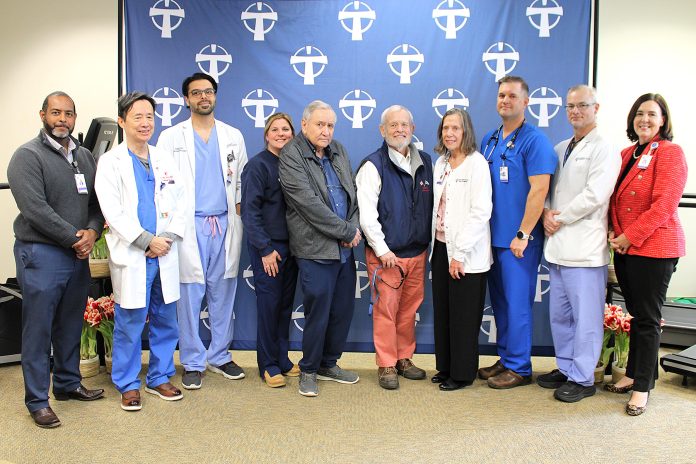
On Tuesday, LeGros and Toups reunited with cardiologist Eric Thomassee, MD, Dr. DeWitt, fellow cardiothoracic surgeon Dr. Safi Haq, and the teams that saved their lives at the third annual Our Lady of Lourdes Heart Hospital Patient Reunion, held each year during American Heart Month.
It Began with a Murmur
Gary LeGros, 70, a Jeanerette City Court judge, had a heart murmur for several years and was under the care of a local cardiologist. The murmur wasn’t causing him any issues, LeGros explained, but doctors wanted to keep an eye on it to be sure it didn’t progress into something more serious. One day, LeGros noticed he was uncharacteristically tired more often.
“I didn’t feel any chest pain or have any typical symptoms of heart trouble,” he said. “My son is a nurse practitioner. He recommended I call Dr. Eric Thomassee for further testing.”
Tests later revealed that LeGros had a calcific aortic valve, which is a gradual buildup of calcium deposits along the walls of the aortic valve causing it to stiffen, thicken and narrow, restricting blood flow. Symptoms associated with the age-related condition include fatigue, shortness of breath, dizziness and heart murmurs.
LeGros soon was admitted to Our Lady of Lourdes Heart Hospital, where he underwent a Transcatheter Aortic Valve Replacement (TAVR). The minimally invasive procedure involves inserting a catheter through an incision in the groin area. A replacement valve is guided into position and deployed over the existing, failing valve.
TAVR is an alternative to open-heart surgery, explained Dr. Thomassee, who performed the procedure with Dr. Haq. Patients typically have shorter hospital stays, reduced recovery time and an improved quality of life.
Acadiana’s first nationally certified Transcatheter Aortic Valve Replacement (TAVR) program, Heart Hospital had its certification renewed in 2024 by the American College of Cardiology (ACC). The ACC certification recognizes the hospital’s expertise and commitment in treating TAVR patients. The recertification was based on evaluation of the staff’s ability to meet standards for multidisciplinary teams, formalized training, shared decision-making and registry performance.
“Everything went exactly the way they said it would,” LeGros said. “I was back duck hunting in no time and living life the way it’s supposed to be lived.”
Breathing New Life
Paul Herman Toups, 84, worked as a savings and loan manager on Broadmoor Boulevard for many years, then he opened a carpet cleaning business and later drove a school bus for Lafayette Parish School System before he retired. Activities at work and home over the years were often strenuous and required a lot of hours. Despite it all, Toups always felt great until, about 10 years ago, he didn’t. So, he went to the Emergency Room.
Toups underwent an angiogram, an X-ray with contrast dye pushed through a catheter to diagnose possible cardiovascular blockage, aneurysms or clots. Cardiologist Dr. Jeffery Chen discovered blockage near Toups’ heart, so he implanted a stent to open the vessel.
Things returned to normal. Then, last October, Toups came down with what he thought was an upper-respiratory infection. “I couldn’t breathe,” he said. “I was having chest pains, but I kept it to myself until I knew it was time to go to the hospital. I tried to ignore the symptoms until I couldn’t anymore.”
A 911 call later, Acadian Ambulance brought Toups to the Our Lady of Lourdes Regional Medical Center Emergency Department, where tests showed he had extensive blockage and a calcific aortic valve, a common disorder in the U.S. that effects an estimated 2.7 million people over age 75. Dr. Thomassee scheduled him for a TAVR procedure.
“The TAVR was a success” Toups said. “I was able to breathe immediately without discomfort.”
This time, one procedure wouldn’t be enough. Toups would have to undergo open-heart surgery, as well, for a triple bypass to address the blockage. But, that would have to wait. Dr. Chance DeWitt, cardiothoracic surgeon with Our Lady of Lourdes Heart Hospital, advised Toups to go home for two weeks to recover from the TAVR and give his body time to recuperate. On November 12, Toups was back at Our Lady of Lourdes Heart Hospital for the bypass surgery, as planned.
“Going in, I was concerned, but I wasn’t worried. Dr. DeWitt did a great job of explaining everything,” Toups noted. “He was very positive throughout the entire process. That really helped ease my fears.”
The entire process was “fantastic,” Toups said. “The nurses watched over me, before the procedure, in surgery and back in my room. Some were passing in the hall, I wasn’t even their patient, but they stopped in to check on me and make sure I had everything I needed, and all my questions answered.”
Today, the father of three, grandfather of nine and great-grandfather of eight is enjoying a better quality of life than he dreamed possible before treatment. He added one final note for the physicians, nurses and other team members involved in his care and recovery:
“You do your job every day with a smile. You answer all questions and put every patient’s mind at ease,” Toups said. “Every step of the way, you made me believe I was going to get better. And, for that, all I can say is thank you.”
