
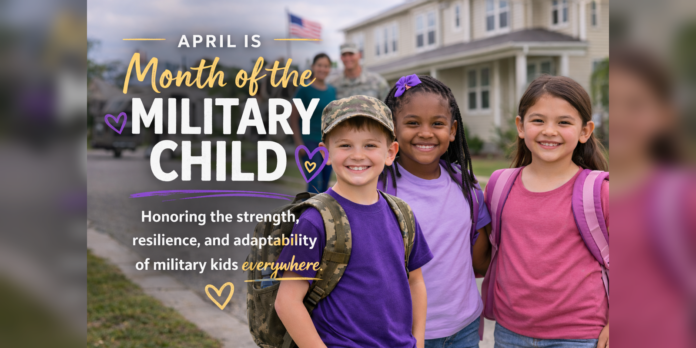

Each April, communities across the United States recognize Month of the Military Child, a time set aside to honor the children of service members whose lives are shaped by military service in ways both visible and unseen.
Often referred to as “military brats,” these children grow up in a world defined by frequent moves, long separations, and a unique blend of resilience and adaptability. While the term may sound unusual to outsiders, within the military community it carries a very different meaning.
Why April Matters
Month of the Military Child was established by the U.S. Department of Defense in 1986 to recognize the sacrifices and contributions of military-connected children. Today, more than 1.6 million children in the United States have a parent serving in the military.
One of the most recognized traditions during April is “Purple Up! Day,” when people wear purple to show support. Purple represents all branches of the military, combining Army green, Navy blue, Air Force blue, Marine red, and Coast Guard blue.
What It Means to Grow Up Military
Military-connected children often attend multiple schools and live in different states or countries before adulthood. They learn early how to adapt, make new friends quickly, and handle change.
At the same time, they face challenges that civilian children may not experience:
- A parent deploying for months at a time
- Uncertainty during times of conflict
- Repeated goodbyes to friends and familiar places
- Adjusting to new schools and cultures
Despite these challenges, many develop strong interpersonal skills, independence, and a broad worldview shaped by their experiences.
Why the Term “Brat” Is Used
The term “military brat” dates back more than a century, and its exact origin is debated.
Some historians trace it to the British military, where “brat” referred to children born into military families. Others suggest it may be tied to the acronym “BRAT,” sometimes said to mean “Born, Raised, and Trained,” though this explanation is widely considered a backronym created later.
Regardless of its origin, the term has evolved within the military community into one of identity and pride.
For many, the term reflects:
- A shared upbringing tied to military life
- A sense of belonging to a global community
- Pride in a parent’s service
- Strength built through constant change
While the word can carry negative connotations outside the military, within this context it is often embraced as a badge of resilience.
A Perspective Shaped by Experience
For those who grew up in military families, the experience often reflects the era in which they lived.
During the years before digital communication, staying connected required patience. Letters were the primary way to keep in touch, and phone calls were limited due to cost.
Many military children do not grow up with a single place to call home. Instead, home may become a collection of places—different states, countries, and memories woven together over time.
These experiences often shape how military children view connection, identity, and belonging—and can influence the adults they become.
Why Recognition Matters
Month of the Military Child is not only about acknowledging challenges, but also about recognizing contributions.
Military children serve in their own way. Their resilience and adaptability support the stability of their families, allowing service members to focus on their duties.
Their experiences—frequent moves, long separations, and constant transitions—are part of the broader story of military service, even if they are not always visible.
Recognizing military children each April affirms that their role matters, their sacrifices are real, and their stories are worth telling.
In recognizing military children, communities also recognize a unique kind of strength—one built not in a single place, but across many.
